

As a firm that practices in this area, we will be interested in this outcome. The United States Supreme Court will review a question about what it means to be a consumer in the Video Privacy Protection Act (“VPPA”), a question that has circuit courts ruling differently.
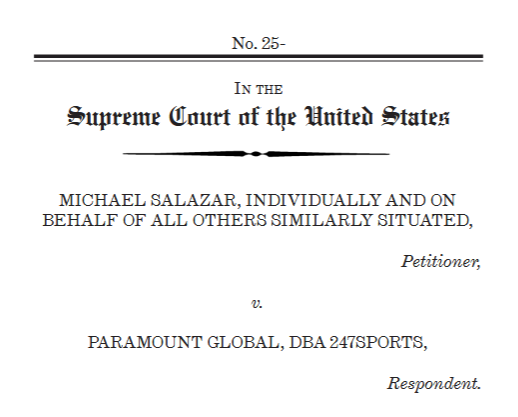
The case is Michael Salazar v. Paramount Global. Plaintiff Salazar subscribed to a 24/7 Sports newsletter, which led him to view videos. He alleges that 24/7 Sports (owned and operated by Paramount Global) sold his viewing information to Facebook (Meta) for advertising purposes.
The issue is whether Salazar is a consumer of audiovisual information.
The question before the court is as follows:
The Video Privacy Protection Act (“VPPA”) prohibits a “video tape service provider” from “knowingly disclosing personally identifiable information concerning any consumer.”
The statute defines “consumer” broadly to include a “subscriber of goods or services from a video tape service provider.” It defines “personally identifiable information” as information that “identifies a person as having requested or obtained specific video materials or services from a video tape service provider.” And it defines “video tape service provider” to include those in the business of delivering audiovisual materials.
Paramount is a “video tape service provider.”
Salazar subscribed to Paramount’s online newsletter, which he used to view videos. Paramount then disclosed Salazar’s Facebook ID and his video-watching history (“personally identifiable information”) to Facebook.
These two points are not disputed.
The question is whether “goods or services from a video tape service provider,” as used in the VPPA’s definition of “consumer,” refers to all of a video tape service provider’s goods or services or only to its audiovisual goods or services.
The VPPA was enacted in 1998 in response to a breach of information about Judge Robert Bork’s rental of video tapes from a video store.